
hornsby dental
DENTAL FILLING/RESTORATION
hornsby dental
DENTAL FILLING/RESTORATION

Dental Filling/Restoration
Restorative Dentistry is integral in the management of oral health. By rebuilding worn, damaged or chipped teeth we can restore the function of the tooth and prevent further wear and tear, hence preserving the tooth natural structure.
How much does a Filling cost ?
Costs of fillings/restorations depends on which tooth and what surfaces is required to be restored. It is best you have a consultation so we are able to give you an accurate price for your individual treatment needs.
Although an indirect filling may be more expensive than a tradition direct filling, it can be as comparable as a direct filling that requires multiple repairs or replacements over time.
Have any questions about fillings/restorations? Do you think you need one? Get in contact with our team where we can discuss which Dental Filling are best option for you.
Dental Filling/Restoration
Restorative Dentistry is integral in the management of oral health. By rebuilding worn, damaged or chipped teeth we can restore the function of the tooth and prevent further wear and tear, hence preserving the tooth natural structure.
How much does a Filling cost ?
Costs of fillings/restorations depends on which tooth and what surfaces is required to be restored. It is best you have a consultation so we are able to give you an accurate price for your individual treatment needs.
Although an indirect filling may be more expensive than a tradition direct filling, it can be as comparable as a direct filling that requires multiple repairs or replacements over time.
Have any questions about fillings/restorations? Do you think you need one? Get in contact with our team where we can discuss which Dental Filling are best option for you.
By regularly visiting your Dentist or Oral Therapist every 6 months for you check-up we can help prevent or pick up early signs of tooth decay or damage. However, SOME symptoms that may indicated that you have a cavity or require a filling/restoration are:
- A visible hole that can be seen by eye or felt with your tongue
- Sensitivity to hot, cold or sweetness
- Tooth ache / pain
- Pain on biting or chewing
- Floss will tear when flossing in between your teeth
- Visible discolouration or grey shadowing below the tooth’s surface
- Rough tooth surface
- Tooth decay on the X-ray
Dental Filling / Restoration Material
Lorem ipsum dolor sit amet, consectetur adipiscing elit. Quisque finibus commodo nibh, ut elementum velit sollicitudin at. Donec suscipit commodo risus. Nunc vel orci eget ligula elementum consequat. Fusce velit erat, convallis scelerisque aliquet ut, facilisis egestas tellus. Quisque sit amet sapien placerat, ultricies sapien ut, vestibulum ex.
Composite fillings, are tooth coloured fillings they look natural and are able to be shade matched to seamlessly blend in with your natural teeth. The material consists of a resin matrix with microscopic/nano size ceramic filler particles.
A choice where aesthetics is of a concern, can be used in cavities of all sizes, from small to large. However, in larger cavities the resin matrix is susceptible to shrinkage once it is cured. Leading to microscopic voids and possible failure or decay next to the filling.
Amalgam is an alloy metallic filling material; it is strong and durable and can last many years. Because they are so strong the filling does not flex microscopically, which over many years may cause cracking of the natural tooth structure surrounding the filling.
There are sometimes concerns with the very low mercury toxicity, but to date there is insufficient evidence that suggests that amalgam is of no concern once the material is set in the mouth. Due to the unnatural appearance of amalgam fillings, and advancements in other restorative materials they have fallen out of favour for many in recent times, our surgery does not offer amalgam fillings.
Glass Ionomer Cement (GIC) is also a tooth-coloured restorative material, it is not as highly aesthetic as composite resin materials. However due to its cement-based nature, it is used in areas where moisture control may be an issue in the mouth.
It bonds directed onto the tooth surface and releases fluoride that can aid in the prevention of cavities, a great option for patients with a high risk of dental decay. The material is not as wear resistant as other materials making it a short to medium term option.
GIC can also provide insulation around nerve tissues, and is often placed as a base for deep cavity fillings/restorations.
An indirect restoration is made outside of the mouth, usually in a dental laboratory or with specialised equipment in the practice. Whilst a crown covers the entirety of the tooth, an Onlay covers the cusp of a tooth and an Inlay fills between the cusps.
It is usually prepared with porcelain or ceramic materials. Ceramic and porcelain fillings provide a natural look, the do not pick up stains like composite and GIC, they overcome issues with shrinkage experiences with direct materials, provide great durability and support to weak tooth structure.
Hornsby Dental-white Dental Fillings
Before
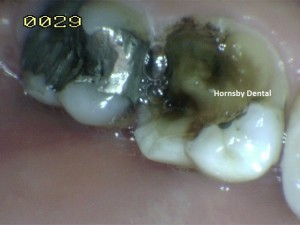
The Patient had a severely decayed and broken down tooth.
After
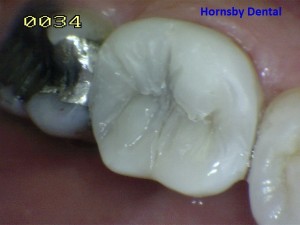
Result of the direct restoration with booth the function and aesthetic of the tooth back to normal
Hornsby Dental Clinic-White Dental Fillings
Before
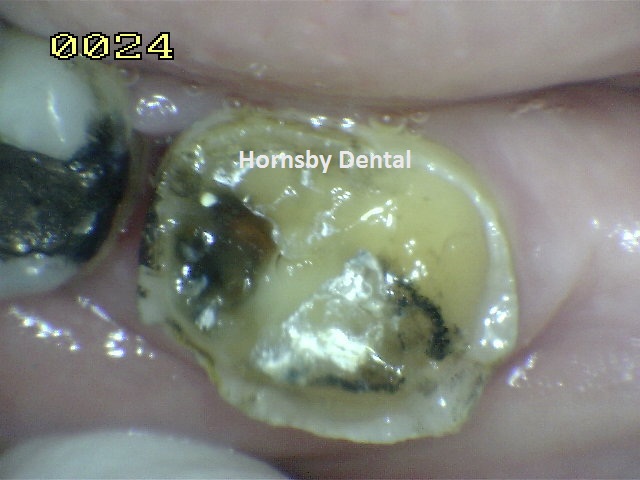
Severely decayed and broken down tooth which basically at the gum line with virtually no function
After
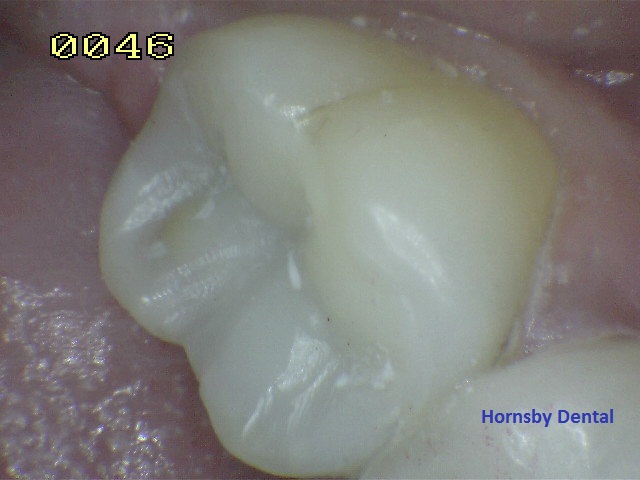
Result of the direct restoration with both the function and aesthetic of the tooth back to normal the patient was very happy with the final result
Hornsby Cosmetic Dentist - Amalgam Fracture (Dental Fillings and Restoration)
Before
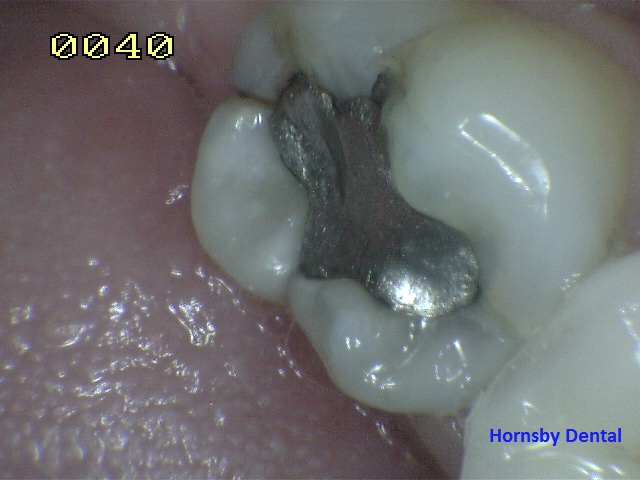
Old silver/amalgam filling that appears to have no apparent problem, however our close examination reveals fracture-lines running across the tooth.
During
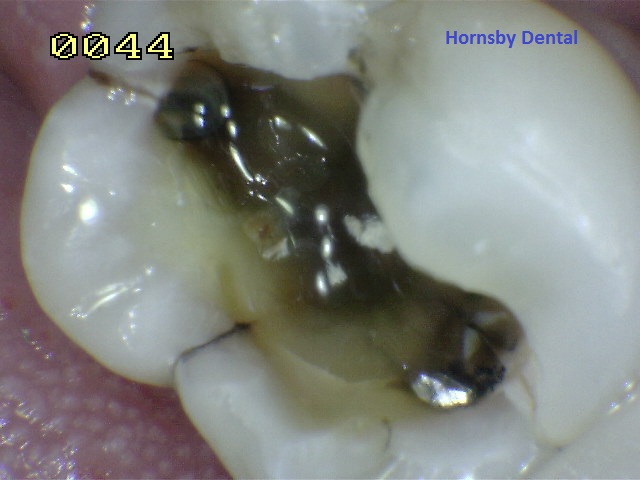
Deep recurrent decay accompanied by clearly visible fracture line. Amalgam restorations that have a high mercury content may behave like mercury in a thermometer – expands when termperature rises (hot food and drinks), and shrinks when cold. This can result in cracks of the tooth that is housing the amalgam.
After
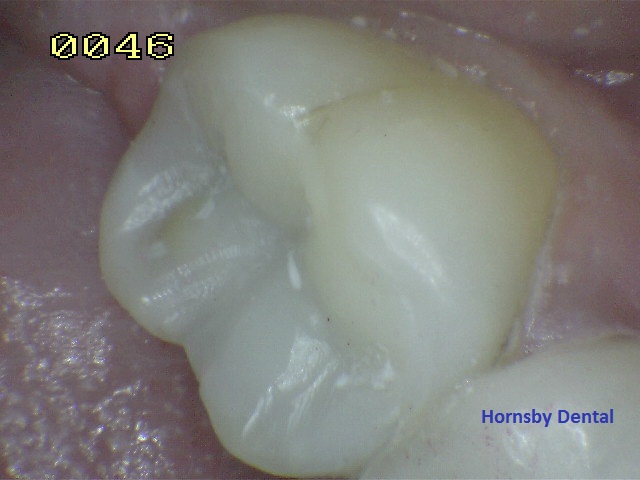
Immediately after amalgam replacement, the tooth is fully functional and highly aesthetic. However given the deep crack that is present underneath the restoration, the tooth is best to have a crown to minimise the risk of tooth fracture.
By regularly visiting your Dentist or Oral Therapist every 6 months for you check-up we can help prevent or pick up early signs of tooth decay or damage. However, SOME symptoms that may indicated that you have a cavity or require a filling/restoration are:
- A visible hole that can be seen by eye or felt with your tongue
- Sensitivity to hot, cold or sweetness
- Tooth ache / pain
- Pain on biting or chewing
- Floss will tear when flossing in between your teeth
- Visible discolouration or grey shadowing below the tooth’s surface
- Rough tooth surface
- Tooth decay on the X-ray
Dental Filling / Restoration Material
Lorem ipsum dolor sit amet, consectetur adipiscing elit. Quisque finibus commodo nibh, ut elementum velit sollicitudin at. Donec suscipit commodo risus. Nunc vel orci eget ligula elementum consequat. Fusce velit erat, convallis scelerisque aliquet ut, facilisis egestas tellus. Quisque sit amet sapien placerat, ultricies sapien ut, vestibulum ex.
Composite fillings, are tooth coloured fillings they look natural and are able to be shade matched to seamlessly blend in with your natural teeth. The material consists of a resin matrix with microscopic/nano size ceramic filler particles.
A choice where aesthetics is of a concern, can be used in cavities of all sizes, from small to large. However, in larger cavities the resin matrix is susceptible to shrinkage once it is cured. Leading to microscopic voids and possible failure or decay next to the filling.
Amalgam is an alloy metallic filling material; it is strong and durable and can last many years. Because they are so strong the filling does not flex microscopically, which over many years may cause cracking of the natural tooth structure surrounding the filling.
There are sometimes concerns with the very low mercury toxicity, but to date there is insufficient evidence that suggests that amalgam is of no concern once the material is set in the mouth. Due to the unnatural appearance of amalgam fillings, and advancements in other restorative materials they have fallen out of favour for many in recent times, our surgery does not offer amalgam fillings.
Glass Ionomer Cement (GIC) is also a tooth-coloured restorative material, it is not as highly aesthetic as composite resin materials. However due to its cement-based nature, it is used in areas where moisture control may be an issue in the mouth.
It bonds directed onto the tooth surface and releases fluoride that can aid in the prevention of cavities, a great option for patients with a high risk of dental decay. The material is not as wear resistant as other materials making it a short to medium term option.
GIC can also provide insulation around nerve tissues, and is often placed as a base for deep cavity fillings/restorations.
An indirect restoration is made outside of the mouth, usually in a dental laboratory or with specialised equipment in the practice. Whilst a crown covers the entirety of the tooth, an Onlay covers the cusp of a tooth and an Inlay fills between the cusps.
It is usually prepared with porcelain or ceramic materials. Ceramic and porcelain fillings provide a natural look, the do not pick up stains like composite and GIC, they overcome issues with shrinkage experiences with direct materials, provide great durability and support to weak tooth structure.
Hornsby Dental-white Dental Fillings
Before
The Patient had a severely decayed and broken down tooth.
After
Result of the direct restoration with booth the function and aesthetic of the tooth back to normal
Hornsby Dental Clinic-White Dental Fillings
Before
Severely decayed and broken down tooth which basically at the gum line with virtually no function
After
Result of the direct restoration with both the function and aesthetic of the tooth back to normal the patient was very happy with the final result
Hornsby Cosmetic Dentist - Amalgam Fracture (Dental Fillings and Restoration)
Before
Old silver/amalgam filling that appears to have no apparent problem, however our close examination reveals fracture-lines running across the tooth.
During
Deep recurrent decay accompanied by clearly visible fracture line. Amalgam restorations that have a high mercury content may behave like mercury in a thermometer – expands when termperature rises (hot food and drinks), and shrinks when cold. This can result in cracks of the tooth that is housing the amalgam.
After
Immediately after amalgam replacement, the tooth is fully functional and highly aesthetic. However given the deep crack that is present underneath the restoration, the tooth is best to have a crown to minimise the risk of tooth fracture.